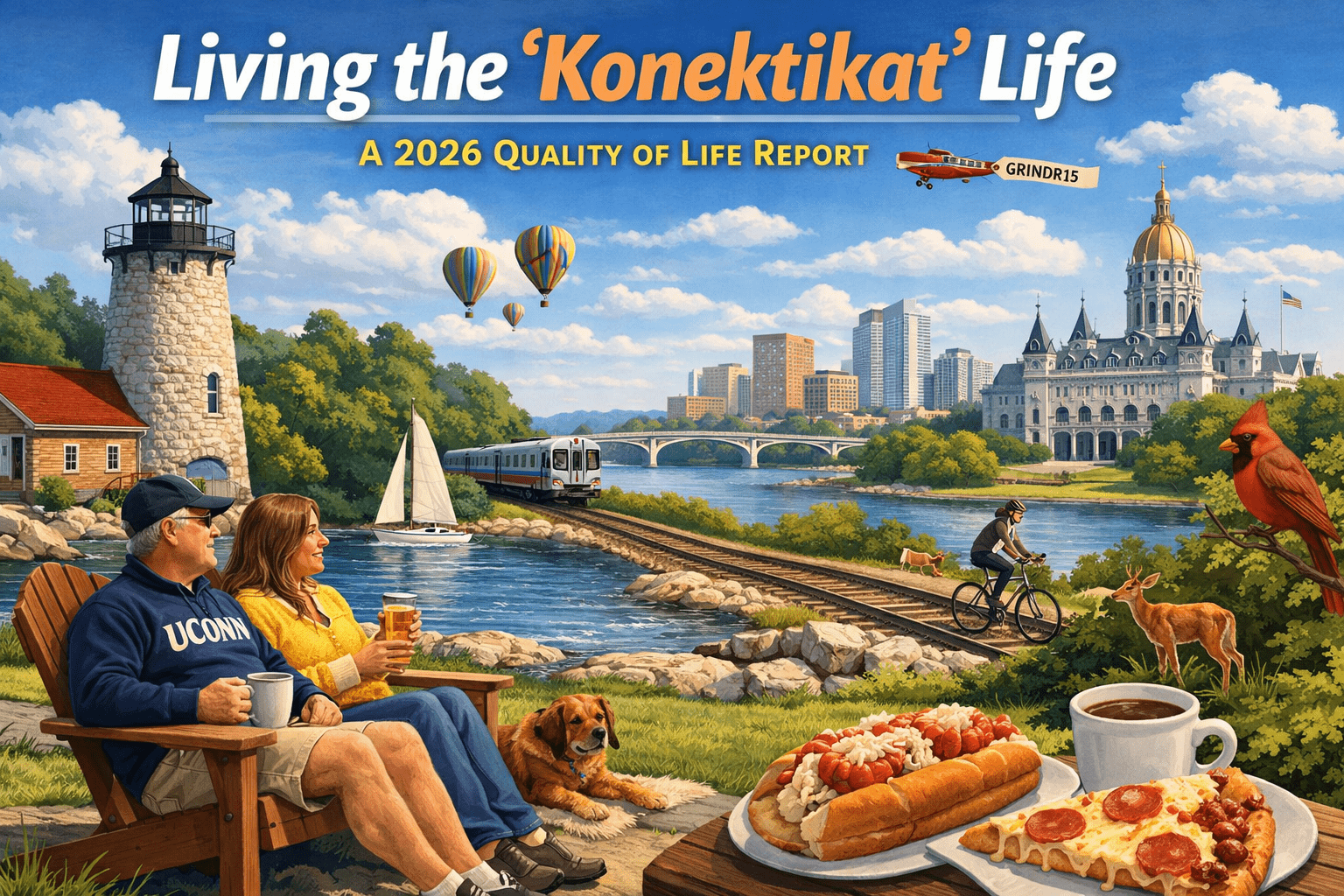
Living the “Konektikat” Life: A 2026 Quality of Life Report
Introduction: The Land of Modern Balance
As we navigate through 2026, the term “Konektikat” has moved beyond being a digital buzzword or a marketing slogan. It now represents a specific lifestyle choice—one defined by the pursuit of balance. While the surrounding metropolises of New York and Boston often demand a high-octane, burnout-prone existence, Connecticut has positioned itself as the “Goldilocks” of the Northeast: urban enough to be exciting, rural enough to be peaceful, and sophisticated enough to be world-class.
Living in Connecticut in 2026 is an exercise in high-value residency. According to recent data, the state ranks 7th in the nation for raising a family, driven by top-tier education and a safety index that remains among the best in the country. However, being a “Konektikater” in 2026 also means navigating a high cost of living and a shifting social landscape. This report explores the day-to-day reality of life in the Constitution State, from the classroom to the commute.
Education: The Jewel of the Constitution State
For many residents, the primary reason for choosing “Konektikat” is the school system. In 2026, Connecticut continues to hold the #5 spot nationally for Education and Child Care. The state’s public schools are not just high-performing; they are evolving.
Towns like West Hartford—recently ranked as the #19 best place to live in the entire United States—serve as the blueprint for this success. Here, the focus in 2026 has shifted toward “whole-child” development, integrating mental health resources and AI-assisted personalized learning into the curriculum. In the “Knowledge Corridor,” schools are increasingly partnering with local industries, ensuring that students are “maker-ready” by the time they graduate.
2026 Education Highlights:
- The “Early Start CT” Initiative: In January 2026, the state added 1,000 new universal childcare spaces, aimed at making it the most family-friendly state in the country.
- University Integration: With UConn and Yale leading the way, the “college town” vibe has leaked into secondary education, providing high schoolers with unprecedented access to research facilities and dual-enrollment programs.
The Economic Reality: Affordability vs. Opportunity
One of the most discussed aspects of the “Konektikat” life is the financial trade-off. In 2026, the state presents a paradox: it is ranked #1 in “Affordability for Families” by some metrics (due to high median salaries and job security), yet it remains one of the most expensive states for housing and utilities.
- The Electricity Factor: Connecticut residents pay some of the highest electric rates in the nation. In 2026, this has led to a massive surge in residential solar adoption and a community-wide push for “Green Bank” subsidized energy efficiency upgrades.
- The Housing Crunch: As noted in our real estate deep dive, housing costs are 20% higher than the national average. However, in 2026, the state has implemented new “vibrancy grants” and zoning reforms to encourage the development of “missing middle” housing—townhomes and apartments that cater to young professionals and teachers who were previously priced out.
Social Life and “Reserved Locals”
A long-standing stereotype of Connecticut is the “reserved” nature of its people—the “Land of Steady Habits” can sometimes feel like the “Land of Private People.” In 2026, however, a new social fabric is being woven.
The state is seeing a “Deepening Commitment” to community-led initiatives. From the rise of Municipal Poet Laureates in towns like Hartford to “Buddy Systems” in schools that pair older students with children with disabilities, the social sector is focused on inclusivity. There is a growing “tech-equity” movement in cities like New Haven, where community centers provide high-speed fiber access and digital literacy training to ensure the “Konektikat” rebrand doesn’t leave anyone behind.
Lifestyle Trends for 2026:
- The “Slow Travel” Weekend: Residents are increasingly vacationing within the state—visiting the Litchfield Hills for farm-to-table dining or the “Quiet Corner” for antique hunting.
- Hybrid Socializing: With a high concentration of remote workers, “Co-working Cafes” have replaced traditional bars as the primary social hub for the 25–40 demographic.
Healthcare: A Leader in Longevity
Quality of life is inextricably linked to health, and here, “Konektikat” shines. The state consistently ranks in the top 10 for Health & Safety. Residents in 2026 benefit from one of the highest densities of primary care physicians and specialists in the world, largely thanks to the influence of the Yale New Haven Health System and Hartford HealthCare.
While healthcare premiums rose by 16.8% for 2026 individual plans, the state government stepped in with over $50 million in backfill funding to protect lower-income families from the brunt of these costs. This proactive “social safety net” approach is a hallmark of the 2026 Connecticut identity—a belief that a high-performing economy must also be a healthy one.
The Challenges: Traffic and Taxes
To provide a candid peer-to-peer review, life in “Konektikat” isn’t without its “cons.”
- The Commute: Despite the rise of remote work, I-95 and the Merritt Parkway remain significant pain points. In 2026, congestion has actually increased as more people move to the suburbs. The state’s response—massive investments in the Metro-North rail line—is helping, but “Traffic” remains a top complaint for residents.
- The Tax Burden: Connecticut still carries one of the highest tax burdens in the country. While 2026 saw some relief through an increased Earned Income Tax Credit (EITC), property taxes in Fairfield County remain a significant hurdle for many.
| Feature | The “Pro” | The “Con” |
| Education | Top 5 National Ranking | High property taxes to fund it |
| Location | Proximity to NYC/Boston | Severe traffic on major arteries |
| Nature | Stunning four seasons | Harsh, high-cost winters |
| Safety | Very low violent crime rates | High cost of security/insurance |
Conclusion: Is the “Konektikat” Life for You?
Living in Connecticut in 2026 is a deliberate choice. It is for the person who values a quiet, safe, and intellectually stimulating environment but is willing to pay the “admission fee” that comes with the Northeast’s high standards.
The state has successfully transitioned from a “corridor” people drive through to a “destination” where people put down roots. Whether you are sipping a latte in a walkable New Haven neighborhood, hiking the blue-blazed trails of the Farmington Valley, or working at a high-tech manufacturing firm in East Hartford, the 2026 reality is clear: the quality of life here is high, the community is resilient, and the future is being “Made Here.”
You may also like to read: Victoria Beckham 2025: Net Worth, Beauty Secrets & New Documentary