Which Deep Freezer Model Actually Saves You Money and Food?
You open the garage door and smell it before you see it. A forgotten pack of chicken thighs, buried under bags of frozen vegetables, has thawed and spoiled. The culprit wasn’t a power outage.
It was poor organization and a unit that couldn’t maintain a consistent temperature. This guide fixes that problem before it costs you another dollar. You will learn exactly how to choose, use, and maintain a deep freezer that fits your household perfectly.
What Exactly Defines a Deep Freezer?
A deep freezer is a standalone appliance designed to reach and sustain much colder temperatures than a typical refrigerator’s freezer compartment. While your kitchen fridge-freezer struggles to hold 0°F, a dedicated deep freezer easily hits and maintains -10°F to -20°F.
This extreme cold creates a hard freeze that locks in nutrients, texture, and flavor for months longer. The name comes from the deep, open storage space, which usually lacks the shallow shelving found in fridge-freezers. You get a large open cavity that swallows bulk purchases whole.
You generally choose between three main styles: a chest deep freezer, an upright deep freezer, or a compact mini deep freezer.
A chest model opens from the top like a treasure box. An upright model opens like a standard refrigerator with a front door and shelves. A mini version gives you a space-saving footprint for smaller households or specific needs like storing breast milk or bait.
Chest Deep Freezer vs. Upright Deep Freezer: The Truth About Design
The biggest battle in the frozen food aisle isn’t between brands; it’s between form factors. Chest and upright models have fundamentally different strengths, and picking the wrong one leads to daily frustration.
The Chest Freezer Advantage
A chest deep freezer wins on physics. Cold air is heavy and sinks. When you open the lid on top, the freezing air pools inside rather than spilling onto the floor. This design makes a chest deep freezer incredibly efficient.
During a power outage, a full chest unit can keep food frozen solid for 48 to 72 hours if you keep the lid shut. You can store large, awkward items like a whole bison roast or a 50-pound bag of flour without issue. The trade-off is clear: you must dig. Without a disciplined system, bottom items vanish into a frozen archeological dig.
The Upright Freezer Advantage
An upright deep freezer or stand up deep freezer sells you organization. Shelves, door bins, and a vertical footprint mean you see everything at a glance. You grab the peas without moving a 15-pound turkey.
The footprint is smaller, fitting into a mudroom corner where a chest might block a walkway. The cold air spills out rapidly when you open the door, making them slightly more expensive to run.
A manual-defrost upright builds frost on the coils faster, requiring more frequent cleaning. A frost-free model solves this but introduces a heating cycle that can cause subtle freezer burn on improperly wrapped food over time.
The Compact Solution
A small deep freezer or mini deep freezer (typically 1.1 to 5 cubic feet) fills a specific gap. It sits on a countertop, fits in a dorm room, or serves as a dedicated beverage station. You find these in both chest and upright styles. Don’t buy a mini model thinking you’ll store a side of beef; buy it to separate your daily-use items from long-term storage in a larger unit.
Temperature Control: How Cold Must a Deep Freezer Get?
Your unit must maintain 0°F. Full stop. That is the hard line where bacteria, mold, and yeast become completely inactive. A high-quality deep freezer can push much lower. What is the lowest temperature a deep freezer can reach? Many reach -10°F as a default and can be adjusted down to -20°F or even colder.
This deep cold creates a quick freeze that forms smaller ice crystals. Smaller crystals do less damage to cell walls in your food, meaning steaks retain their juices and strawberries don’t turn to mush when thawed.
What temperature should a deep freezer be for daily use? Set the thermostat to -10°F. This gives you a safety buffer. If the compressor cycles off, the thermal mass of the food holds the temperature low for a long time.
Buy a cheap, standalone appliance thermometer. Don’t trust the exterior dial. Place the thermometer inside, check it daily for a week, and adjust until the core temperature sits rock-solid at -10°F. For flash-freezing fresh produce, bump the thermostat to the coldest setting 2 hours before loading, then return it to -10°F.
How to Organize a Deep Freezer Like a Professional
A chaotic freezer wastes money. You buy duplicates because you cannot find what you have. You lose vacuum-sealed steaks to the abyss. How to organize a deep freezer starts with a system that works with human laziness.
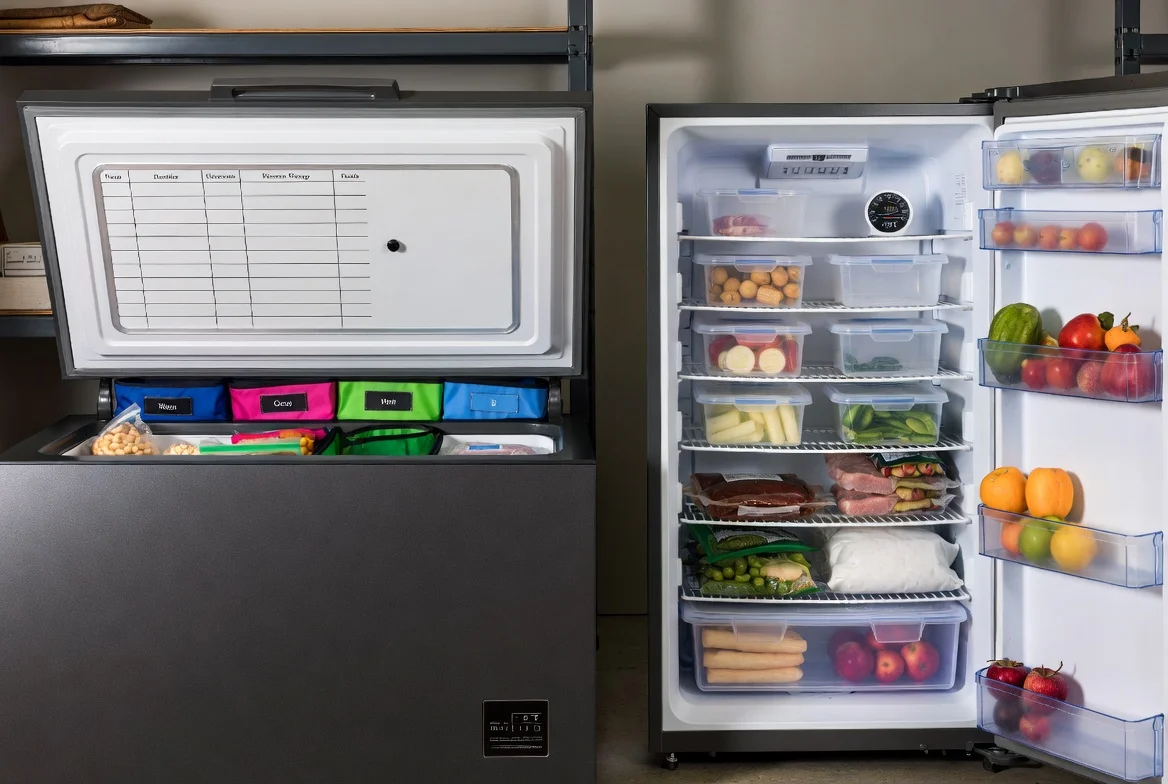
First, categorize everything into zones. Use heavy-duty reusable shopping bags or color-coded fabric bins with sturdy handles. Assign one bin for beef, one for pork, one for chicken, and one for vegetables.
In an upright model, dedicate whole shelves. Label every bin on the front with a bold, permanent marker. For a chest model, stack the bins vertically inside so you can lift them out without climbing in. The “first in, first out” rule must be physical: place newer items at the bottom or back, and move older items to the top or front.
Keep a magnetic whiteboard on the lid or door. List the contents of each bin with a tally of remaining items. When you pull the last pack of chicken thighs, erase that line.
This single habit eliminates the dreaded “freezer inventory panic” before a grocery run. Vacuum seal everything. Air is the enemy. It causes oxidation and freezer burn. A vacuum sealer pays for itself in six months by preventing food waste.
How to Defrost a Deep Freezer Fast Without Damaging It
Ice buildup over ¼ inch insulates the walls from the food, forcing the compressor to run hotter and longer. How to defrost a deep freezer quickly and safely protects your investment. Turn the unit off and unplug it. Remove all food and place it in a tightly sealed cooler with ice packs. Never chip at the ice with a sharp knife or ice pick. The appliance is immediately destroyed by a punctured refrigerant line.
Place a large pot of boiling water inside on a trivet or thick folded towel. Close the lid or door. The steam works faster than any hair dryer and won’t warp the plastic liner. Wait 5 to 10 minutes, then use a plastic scraper or silicone spatula to lift large sheets of ice away.
Wipe the interior dry with clean towels. Do not leave any moisture behind; it turns to new ice instantly when you restart the unit. Plug it back in, set to the coldest setting, and let it run for 30 minutes before reloading. The fast drop in temperature seals the liner and prevents rapid re-frosting.
Can You Place a Deep Freezer Outside or in an Unheated Garage?
Manufacturers build appliances for climate-controlled homes. Yet, millions of people need to know: can you put a deep freezer outside? The answer depends completely on your climate and the unit’s specifications.
A standard deep freezer is rated for a specific “climate class.” If you place a unit rated for indoor use in a garage that drops to 20°F in winter, the compressor oil thickens. The unit struggles to start, or the thermostat wrongly reads the ambient cold as the interior temperature, shutting off and letting the food thaw.
In summer, an uninsulated garage hitting 110°F forces the compressor to run nonstop, overheating and failing within a few years.
If you must keep a deep freezer in a garage, buy a “garage-ready” model. Brands like Gladiator or specific GE garage-ready units have a wider operating temperature range.
If you choose a standard model, build a small, insulated enclosure around it that does not block the ventilation grilles. Always check the owner’s manual for the minimum and maximum ambient temperature rating. A screened-in porch offers zero protection from temperature swings or humidity, which rusts the exterior and ruins door seals.
Real-World Power Use: Amps, Watts, and How Long It Stays Cold
How many watts does a deep freezer use? A modern 7 to 15 cubic foot ENERGY STAR model draws between 25 and 45 watts during normal running. At startup, the compressor can spike to 200-250 watts for a split second.
How many amps does a deep freezer use? Typically 0.5 to 1.5 amps on a standard 115-volt circuit. This is incredibly efficient. A $30 annual electric bill is normal for a medium chest unit. An upright auto-defrost model uses more, closer to 50-80 watts, because the defrost heater cycles on regularly.
How long will a deep freezer stay cold without power? A full, unopened chest unit stays safe for 48 hours. A half-full unit drops to 24 hours. An upright with a poor door seal drops to less than 12 hours.
To maximize time, slide an instant-read thermometer probe between two packages without opening the door. Tape the readout to the outside. If the temperature climbs above 32°F, cook or process the food immediately. Never open the door just to check.
Deep Freezer Pricing and Where to Find the Best Deals
How much is a deep freezer? The cost varies wildly by size, type, and trim. A budget 3.5 cubic foot magic chef deep freezer or hisense deep freezer in chest format runs $150 to $200.
These models excel as secondary storage. A midsize 7 cubic foot chest from walmart deep freezer selection or lowes deep freezer brands ranges $250 to $400. An upright frost-free model in the 13 to 17 cubic foot range climbs from $500 to $900. High-end garage-ready units and commercial-grade units exceed $1200.
Searching for “deep freezer for sale” or “cheap deep freezer” during July and January yields the best results. Retailers like home depot deep freezer departments and Lowe’s clear inventory around Independence Day and New Year’s. They make room for new inventory, and scratch-and-dent units in functional condition drop by 40-60%.
A cosmetic dent on the side panel does not affect performance. A dented door seal or lid gasket, however, must be rejected outright. When hunting a “deep freezer sale,” buy the deepest size you can afford and fit. You will fill it faster than you think.
Global Deep Freezer Pricing Benchmarks B2B 2026 (Snapshot)
(Note: These are estimated wholesale FOB price ranges for bulk orders, not retail.)
| Freezer Type | Volume (Cu. Ft.) | Est. 2026 B2B Price Range (USD) | Key Buyers |
| Compact Chest | 3.5 – 5.0 | $85 – $125 | Hospitality, Small Retail |
| Medium Chest | 7.0 – 10.0 | $140 – $210 | Supermarkets, Catering |
| Large Chest | 15.0 – 22.0 | $250 – $400 | Meat Processing, Restaurants |
| Solid-Door Upright | 10.0 – 15.0 | $220 – $340 | Pharmacies, Labs |
| Glass-Door Upright | 12.0 – 18.0 | $310 – $500 | Ice Cream Shops, Convenience |
| Explosion-Proof | 5.0 – 10.0 | $950 – $1,800+ | Chemical, Industrial |
Source: Aggregated trade data from Hong Kong Import & Export Association reports and verified Alibaba.com Gold Supplier pricing averages for Q1 2026 projections.
Style and Finish: Black Deep Freezer Trends and More
The days of a white box being the only option are over. A black deep freezer or stainless-steel wrapped upright now integrates into a modern garage gym, wet bar, or basement lounge. A black deep freezer with a smooth matte finish hides fingerprints and dents better than a glossy white panel. Brands offer trim kits and even custom panel-ready models to match cabinetry. If the unit sits in a visible area, pay the $50-$100 premium for the aesthetic upgrade. You will treat the appliance better because it looks intentional rather than like an afterthought.
How Long Until a New Deep Freezer Gets Cold?
You just plugged in a brand new unit and filled it with expensive groceries. That’s a mistake. How much time does it take for a deep freezer to cool down? It needs 4 to 6 hours to pull down to safe storage temperatures when completely empty.
Plug the unit in, set it to the coldest setting, and let it run completely empty for 4 hours. Place your thermometer inside to confirm it hits -10°F. Next, gradually load food at room temperature over a few hours.
Loading a hot pot of chili directly into a new, empty freezer overloads the compressor. Pre-chill everything in the refrigerator before moving it to the deep freezer. This practice shortens the pull-down time and saves significant energy.
Frequently Asked Questions (FAQs)
What is a deep freezer?
A deep freezer is a standalone freezing appliance that maintains temperatures of -10°F to -20°F, much colder than a standard fridge-freezer, for long-term food preservation.
Is a chest freezer the same as a deep freezer?
One kind of deep freezer is a chest freezer. Deep freezer refers to the extreme cold capability and design, while the chest describes the top-opening, horizontal body style.
How cold should a deep freezer be for safe storage?
A deep freezer must maintain 0°F. For optimal, long-term texture retention, set the thermostat to -10°F and verify with an independent thermometer.
What is considered a deep freezer when I search for one locally?
Searching for a “deep freezer near me” includes any dedicated, standalone freezer unit, including standing deep freezer models, upright deep freezer units, and compact chests, sold at appliance, hardware, and big-box stores.
How much electricity does a deep freezer use compared to my fridge?
A modern chest deep freezer uses significantly less electricity than a refrigerator because you rarely open it and cold air stays trapped. An ENERGY STAR chest unit can cost under $30 annually to run.
Can a deep freezer be outside on a covered porch?
A standard deep freezer should not be placed outside on a porch. Exposure to humidity, rain, and daily temperature swings will rapidly damage the electrical system, rust the cabinet, and destroy the door seal.
Your Move: Lock in the Cold Before You Lose Another Dollar
You now have the exact blueprint to stop food waste, save hundreds on bulk meat purchases, and pick a unit that matches your real life rather than some salesman’s ideal. The best moment to buy a deep freezer is right now, armed with this knowledge. Walk into the store or open your browser, find the size that fits your space, and demand a garage-ready rating if it goes anywhere other than your kitchen.